
Many bacteria and archaea have developed defense mechanisms that allow them to withstand viral infection and exposure to foreign nucleic acids. Clustered Regularly Interspaced Short Palindromic Repeats (CRISPR), known for their role in genetic diversity, have also emerged as a powerful tool in the field of CRISPR gene editing. These genetic loci provide acquired immunity against these external insults, making them a key player in the world of molecular biology and biotechnology.
How CRISPR works:
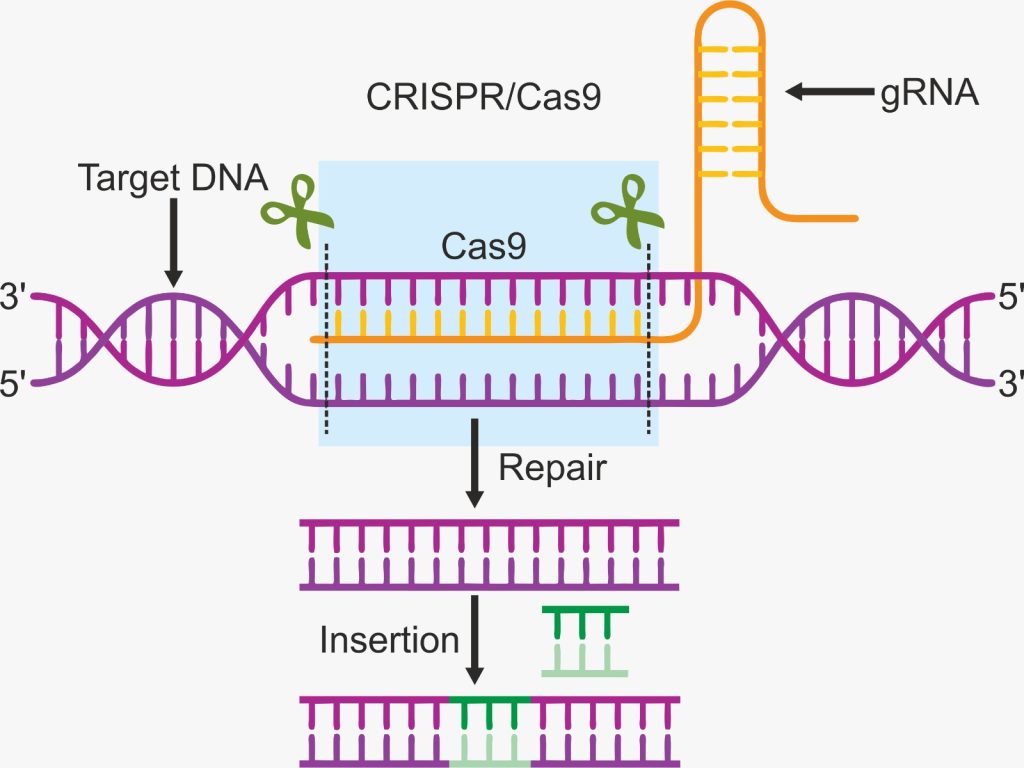
The mechanism of CRISPR/Cas9 genome editing contains three steps: recognition, cleavage and repair. CRISPR works by using a specific type of RNA molecule, called guide RNA (gRNA) that recognizes the target sequence in the gene of interest trough a complementary base pair. to direct a protein called Cas9, a nuclease enzyme, to a specific location in the genome. Once the Cas9 protein reaches its target, it can cut both strands of the DNA at that location. The cell’s natural repair mechanisms then kick in, either repairing the cut or introducing a desired genetic change at that location.
In the last 10 years, it has been demonstrated that CRISPR can be used for eukaryotic genetic modification, with a profound impact on scientific research and revolutionizing experimental therapies in multicellular organisms, including humans. CRISPR has several advantages over previous gene-editing technologies. It is faster, cheaper, and more precise than other methods. Additionally, it can be used in a wide variety of organisms, making it a versatile tool for genetic research and therapy.
Potential Applications in Experimental Therapies:
CRISPR has the potential to revolutionize experimental therapies in a variety of ways. One of the most promising applications of CRISPR is in the treatment of genetic diseases. The use of CRISPR/Cas9 to correct or replace faulty genes would cure diseases such as cystic fibrosis, Duchenne muscular dystrophy and sickle cell anemia.
Another potential application of CRISPR in experimental therapies is in the treatment of oncologic patients. CRISPR would allow to target and destroy cancer cells, potentially leading to more effective and less toxic treatments.
In addition, CRISPR opens new avenues to create innovative therapies for diseases that currently have no cure. For example, researchers have used CRISPR to create T cells programmed to attack cancer cells. These modified T cells could then be utilized to treat a variety of different types of cancer.
Challenges to overcome:
While CRISPR has enormous potential in the field of experimental therapies, there are still several challenges that must be overcome before it can become a widely used treatment. Nowadays, one of the biggest challenges is delivery, as, in order to use CRISPR to treat diseases, it must first reach the specific cells or tissues that need to be treated. Researchers are currently exploring a variety of different targeting methods for delivering CRISPR, including viral vectors and nanoparticles.
Another challenge is the possible off-target effects. Although highly precise, CRISPR is not perfect and there is always the potential for unintentional editing other genes. Researchers are working to minimize these off-target effects, but it will be important to thoroughly test any CRISPR-based therapies for unintended consequences.
Summary:
CRISPR is a revolutionary technology that has the potential to revolutionize experimental therapies. Its precision and versatility makes it a powerful tool for both genetic research and gene therapy. While there are still challenges to conquer before CRISPR can be widely used in clinical settings, the potential benefits are enormous. CRISPR-based therapies have the potential to cure genetic diseases, treat cancer, prevent the transmission of hereditary disease and create new therapies for currently untreatable diseases. Apart from medicine, this technology has a number of applications in the areas of agriculture, veterinary sciences and biotechnology. This is the reason why Arcentech will carry out an exhaustive monitoring of the advances in this technique, due to its possible applications in technological projects.
However, although CRISPR has opened a new era in molecular biology and has countless applications ranging from basic molecular research to clinical applications, the road ahead is paved with challenges and ethical issues that will take time to overcome.